
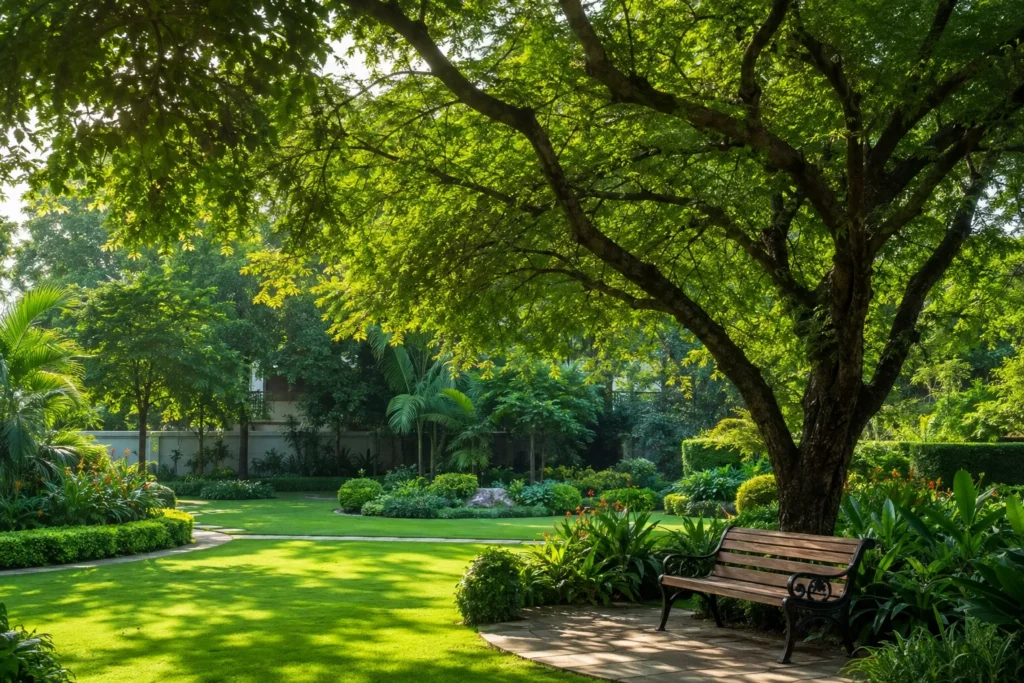
Trees are an important part of good landscaping. They give shade, cool the area, improve air quality, and make outdoor spaces look fresh. In cities like Pune, trees are also useful for reducing the heat around homes, offices, hotels, schools, and other commercial spaces.
Choosing the right tree is not only about beauty. A good landscape plan should consider tree size, sunlight, soil, water, roots, maintenance, and the space available.
If you are planning a garden, office landscape, residential landscape, or commercial outdoor area, knowing the best 10 Shade Trees in India can help you make a better choice.
For professional projects, experienced Landscaping Services in Pune can also help select trees that suit the local climate and site conditions.
What Are Shade Trees?
Shade trees are trees that grow a wide crown or canopy. Their branches and leaves create shade below the tree.
A mature shade tree can help make an outdoor area more comfortable. It can also add beauty and structure to a landscape.
Some shade trees are suitable for large gardens, while others can work well in parks, campuses, roadsides, and commercial properties.
The best tree depends on:
- Available space
- Soil type
- Sunlight
- Water availability
- Tree growth rate
- Mature height
- Root growth
- Maintenance needs
- Local climate
- Purpose of the landscape
This is why tree selection is an important part of professional landscaping services.
Why Are Shade Trees Important in Landscaping?
Shade trees do much more than provide a place to sit under.
They can become the main feature of a garden. They can also create a natural cooling effect and improve the overall look of a property.
Here are some important benefits.
1. Natural Shade
The main benefit is simple: trees provide shade.
A large tree can create a comfortable sitting area in a garden, courtyard, campus, or outdoor workplace.
2. Helps Reduce Heat
Trees can help reduce direct sunlight on buildings, walkways, parking areas, and open spaces.
This is especially useful in warm Indian cities.
3. Better Outdoor Comfort
A shaded garden can feel more comfortable than an open area exposed to direct sunlight.
This makes shade trees useful for parks, resorts, schools, offices, and residential gardens.
4. Improves Landscape Beauty
Large trees add height, shape, colour, and natural beauty to a landscape.
They can also make a new garden look more mature over time.
5. Supports Biodiversity
Trees can provide shelter and food for birds, insects, and other small animals.
A well-planned landscape can therefore support a healthier local ecosystem.
6. Creates Privacy
Trees with dense foliage can act as a natural screen between two properties or outdoor spaces.
This can be useful for homes, hotels, restaurants, offices, and resorts.
10 Shade Trees in India for Beautiful Landscapes
India has many trees that can provide excellent shade. However, not every tree is suitable for every location.
Here are 10 popular shade trees that can be considered for landscape planning.
1. Rain Tree
The Rain Tree is one of the well-known large shade trees in India.
It develops a broad canopy with spreading branches. Because of its large crown, it can create a wide shaded area.
Rain Trees are often seen along roads, in large campuses, parks, and open areas.
Best for: Large gardens, campuses, parks, roadsides, and large commercial properties.
Important point: This tree needs plenty of space. It may not be suitable for a small garden.
2. Neem Tree
Neem is a popular Indian tree known for its hardy nature.
It can provide good shade and can grow in many conditions. Neem is often used in residential areas, educational campuses, farms, and public landscapes.
Its green leaves also add a natural look to gardens.
Best for: Homes, schools, campuses, parks, and larger gardens.
Landscape tip: Give the tree enough room to grow and avoid planting it too close to buildings or underground services.
3. Indian Banyan
The Banyan is one of India’s most famous trees.
It can become very large and develop a wide canopy. Mature Banyan trees can create large shaded spaces.
Because of its size and root growth, it is better suited to very large open areas.
Best for: Large parks, institutional campuses, heritage landscapes, and public gardens.
Important point: Banyan trees need a lot of space and careful planning.
4. Peepal Tree
The Peepal tree is another well-known Indian tree.
It can grow into a large tree with a wide crown. Its natural form can add character to a landscape.
Peepal trees are generally better for open spaces where they have enough room to grow.
Best for: Large gardens, public spaces, campuses, and open landscapes.
Important point: Consider future root and canopy growth before planting.
5. Gulmohar
Gulmohar is loved for its beautiful flowers as well as its spreading canopy.
During its flowering season, the bright flowers can create a strong visual feature in a garden or outdoor space.
It can be used where both shade and ornamental value are needed.
Best for: Gardens, avenues, campuses, parks, and residential landscapes.
Gulmohar is a good example of how a tree can provide both shade and ornamental beauty.
6. Arjun Tree
The Arjun tree is a strong Indian tree often used in larger landscapes.
It has a tall and attractive form and can provide shade as it matures.
It may work well in larger properties where there is enough growing space.
Best for: Large gardens, campuses, parks, and institutional landscapes.
Good soil preparation and proper planting can help the tree establish well.
7. Mango Tree
The Mango tree is well known across India.
Apart from producing fruit, a mature Mango tree can provide useful shade. It can be a practical choice for larger residential gardens, farmhouses, and open properties.
Its dense foliage can create a pleasant green space.
Best for: Large home gardens, farmhouses, orchards, and open properties.
Important point: Fruit-bearing trees need suitable care, cleaning, and seasonal maintenance.
8. Indian Almond
Indian Almond, also called Tropical Almond, can develop a broad and attractive canopy.
Its large leaves and spreading shape can give a landscape a tropical feel.
It can be considered for suitable warm-climate landscapes with enough space.
Best for: Large gardens, resorts, hotels, parks, and tropical-style landscapes.
Its final size should always be considered before planting.
9. Jamun Tree
Jamun is another useful tree for Indian landscapes.
It can become a large tree with dense foliage and provide good shade.
It also produces edible fruit, making it useful for some residential and larger garden settings.
Best for: Large gardens, farmhouses, campuses, and open spaces.
Because fruit may fall on paths or parking areas, the planting location should be planned carefully.
10. Copperpod Tree
Copperpod is valued for its attractive foliage and yellow flowers.
It can add colour and shade to larger outdoor areas.
It is often considered for avenues, gardens, institutional properties, and commercial landscapes.
Best for: Parks, campuses, large gardens, roadsides, and commercial landscapes.
A landscape designer can help decide the right planting distance based on the available space.
How to Choose the Right Shade Tree for Your Property?
Choosing a tree should not be based only on its appearance.
A tree may look beautiful in a photo but may not be right for your property.
Consider these points before planting.
Check the Available Space
First, look at the space.
Ask:
- How much open land is available?
- How tall can the tree become?
- How wide can the canopy become?
- Is there enough space for the roots?
Large trees should not be planted in very small areas.
Consider the Pune Climate
Pune has a warm climate with a distinct monsoon season. Tree selection should consider local weather, soil, sunlight, and water conditions.
This is one reason Landscaping Services in Pune should start with a site assessment instead of simply choosing trees from a list.
Think About Tree Roots
Roots need space too.
Planting a large tree too close to a building, wall, drainage line, pavement, or underground utility can create future problems.
Proper planning can reduce these risks.
Look at Maintenance Needs
Every tree needs some care.
Maintenance may include:
- Watering
- Pruning
- Removing dead branches
- Mulching
- Soil care
- Pest monitoring
- Cleaning fallen leaves
- Seasonal inspection
A professional landscape maintenance service can help keep trees healthy and the outdoor area neat.
Think About the Purpose
Ask what you want the tree to do.
Do you need:
- Shade?
- Privacy?
- Flowers?
- Fruits?
- A green backdrop?
- A roadside tree?
- A seating area?
- A focal point for the garden?
Your answer will help you choose the right species.
Best Shade Trees for Different Landscapes
Different properties need different types of trees.
For Residential Gardens
Neem, Mango, Jamun, and Gulmohar can be considered for larger residential gardens.
The final tree size should always be checked before planting.
For Office Landscapes
Office landscapes need trees that improve outdoor comfort without creating difficult maintenance problems.
Trees can be placed around lawns, walkways, outdoor seating areas, and open spaces.
For Hotels and Resorts
Hotels and resorts often need both shade and visual beauty.
Flowering and broad-canopy trees can help create attractive outdoor spaces for guests.
For Parks
Large public parks can support bigger trees because they normally have more open land.
Rain Tree, Banyan, Peepal, and other large shade trees may work in suitable locations.
For Commercial Properties
Commercial landscapes need careful planning.
Trees should not block signs, entrances, parking areas, pathways, or important building features.
This is where a professional commercial landscaping service can be useful.
How Professional Landscaping Services Help With Tree Selection
Tree planting looks simple, but good landscaping requires planning.
A professional landscape team can study the property before selecting plants and trees.
The process may include:
Site Assessment
The site is checked for sunlight, soil, drainage, available space, existing plants, and structures.
Landscape Planning
Trees, shrubs, lawns, flowers, pathways, and other landscape elements are planned together.
Tree Placement
The right distance is considered between trees, buildings, walls, roads, pathways, and utilities.
Soil Preparation
Good soil preparation can help new trees establish healthy roots.
Planting
Correct planting depth, spacing, support, and watering are important during the early growth stage.
Regular Maintenance
Trees need care after planting. Pruning, watering, soil care, and regular monitoring help maintain the landscape.
This complete approach makes professional landscaping services more effective than simply planting trees without a plan.
Common Mistakes When Planting Shade Trees
Even a good tree can become a problem when planted in the wrong place.
Avoid these common mistakes.
Planting a Large Tree in a Small Area
Always consider the mature size of the tree.
Planting Too Close to Buildings
Leave enough space for future canopy and root growth.
Ignoring Water Requirements
Some trees need more water during establishment. Others may tolerate dry conditions better.
Choosing Only for Appearance
A beautiful tree may not be suitable for your soil, climate, or available space.
Poor Pruning
Incorrect pruning can damage a tree.
Tree pruning should be done carefully and at the right time.
Ignoring Underground Utilities
Before planting, check for underground pipes, drainage systems, cables, and other services.
Shade Trees and Sustainable Landscaping
Shade trees can play an important role in sustainable landscaping.
A well-planned landscape can use trees, native plants, ground covers, rainwater management, and suitable irrigation together.
Trees can provide shade while other plants fill the lower levels of the landscape.
This creates a more natural and balanced outdoor space.
For modern landscape design, the goal is not simply to plant more trees. The goal is to select the right plants for the right place.
Frequently Asked Questions About Shade Trees in India
Which is the best shade tree in India?
There is no single best shade tree for every property. Rain Tree, Neem, Banyan, Peepal, Gulmohar, Arjun, Mango, Jamun, Indian Almond, and Copperpod can all provide shade in suitable conditions.
The best choice depends on space, climate, soil, water, and maintenance needs.
Which shade trees are suitable for Pune?
Suitable choices depend on the property and site conditions. Neem, Gulmohar, Rain Tree, Mango, Jamun, and other suitable species may be considered for Pune landscapes.
A site assessment is recommended before final selection.
Which tree gives the most shade?
Large trees with wide, dense canopies can provide significant shade. Rain Tree and Banyan are examples of trees that can develop very large canopies when given enough space.
Which trees are good for office landscaping?
Trees for office landscapes should be selected based on available space, maintenance needs, root behaviour, and the desired appearance.
Medium or large trees can be used around lawns, walkways, outdoor seating, and open areas where suitable.
How far should a shade tree be planted from a building?
There is no single distance for every tree. The mature height, canopy width, root system, building design, and underground services should be considered.
Large trees generally need more space than small trees.
Do shade trees need regular maintenance?
Yes. Young trees need proper watering and care while establishing. Mature trees may need pruning, health checks, soil care, and removal of damaged branches.
Can shade trees reduce outdoor heat?
Trees can provide shade and reduce direct sunlight on outdoor surfaces. Vegetation can also improve the comfort of outdoor spaces.
The actual cooling effect depends on tree size, canopy, location, weather, and surrounding surfaces.
Final Thoughts
Shade trees can change the way an outdoor space looks and feels.
The right tree can provide shade, beauty, privacy, greenery, and better outdoor comfort. But tree selection should always consider the future size of the tree, root growth, soil, sunlight, water, and maintenance.
For homes, offices, hotels, schools, parks, and commercial properties, good planning is the key to successful landscaping.
If you are planning a new garden or want to improve an existing outdoor area, Interioforest can help you understand the landscape requirements and plan suitable greenery for your space.
Plan Your Landscape With the Right Trees
A beautiful landscape starts with the right plan—not simply with planting more trees.
If you are looking for reliable Landscaping Services in Pune, contact Interioforest to discuss your garden, office, commercial property, hotel, or outdoor landscape requirements.
Contact us today to plan a greener, cooler, and more beautiful outdoor space with the right trees and landscape design.