
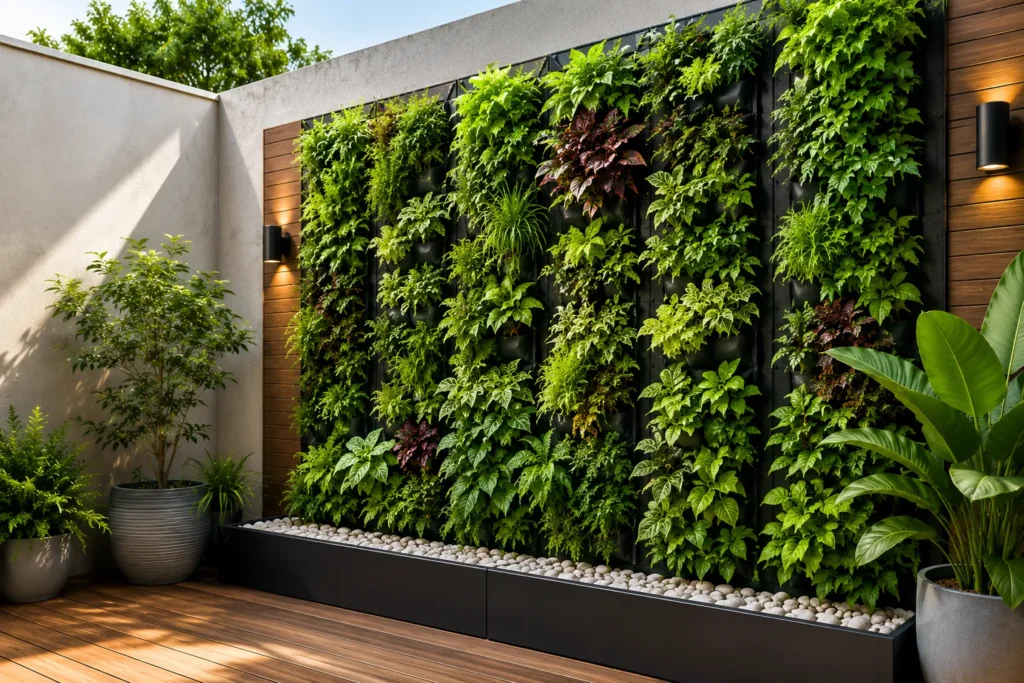
If you have ever looked at a bare balcony wall in your Pune apartment and wished it were green instead of grey, you are not alone. As plots shrink and apartment balconies become the only outdoor space many of us have, more homeowners and businesses across the city are turning to a vertical garden design and installation service in Pune to bring greenery back into their lives without needing a single square foot of ground.
This guide covers everything you need to know: what a vertical garden actually is, how vertical gardening works, how to install one yourself or hire a professional, how to build a vertical vegetable garden, and why green walls genuinely help the environment — not just your Instagram feed.
What Is a Vertical Garden?
A vertical garden, also called a green wall or living wall, is a structure that lets plants grow upward along a vertical surface instead of spreading across the ground. Instead of a traditional flowerbed, plants are held in a frame, pocket system, or modular planter that is mounted on a wall, railing, or freestanding structure.
Vertical gardens generally fall into three categories:
| Type | How It Works | Best For |
|---|---|---|
| Panel/Pocket system | Breathable fabric pockets or modular trays fixed to a frame | Balconies, indoor feature walls |
| Trellis-based | Climbing plants trained up a wire or wooden trellis | Outdoor walls, terraces, fences |
| Modular planter wall | Interlocking plastic or metal planters stacked vertically | Vegetable gardens, herb walls |
Unlike a plain hanging planter or a single climber on a wall, a true vertical garden is a designed system — with its own soil medium, drainage, and usually a built-in or manual irrigation line — engineered so every plant gets the light, water, and root space it needs even though it is growing sideways or upside down relative to a normal bed.
How to Do Vertical Gardening: The Basics
Vertical gardening is simply the practice of growing plants upward using supports, frames, or stacked containers rather than letting them spread horizontally. It works because most plants only need three things to thrive — light, water, and a stable root zone — and none of those strictly require flat ground.
To do vertical gardening successfully, you need to get four fundamentals right:
- Structure: A frame, trellis, or panel system strong enough to bear the weight of wet soil and mature plants.
- Growing medium: A lightweight, well-draining mix so pockets or planters do not become waterlogged.
- Irrigation: Either manual watering from the top or, ideally, a drip irrigation line so water reaches every tier evenly.
- Plant selection: Species suited to your wall’s light exposure and Pune’s climate — more on this below.
How to Install a Vertical Garden: Step-by-Step
If you want to understand how to install a vertical garden — whether you plan to DIY a small balcony version or brief a professional installer — the process generally follows six stages.
- Assess the space. Note the wall’s sun exposure (full sun, part shade, or shade), the wall material, and whether the surface can take drilled fixings or needs a freestanding frame instead.
- Choose the system type. Decide between a fabric pocket panel, a modular planter wall, or a trellis with climbers based on the look you want and your budget.
- Install the frame or backing. Mount a waterproof backing layer first (especially indoors) to protect the wall, then fix the frame or trellis securely.
- Set up irrigation. Run a drip line with an emitter at each pocket or tier, connected to a timer if possible, so watering is consistent even when you are away.
- Add growing medium and plants. Fill pockets or planters with a lightweight, well-draining mix, then plant densely enough to fill in quickly but leave room for root growth.
- Test drainage and settle in. Water thoroughly, check that excess water drains away cleanly (not onto flooring or a neighbour’s balcony), and monitor the first two to three weeks closely as plants establish.
For larger installations, structural load, waterproofing behind the wall, and drainage routing are best assessed by an experienced team — this is where a professional vertical garden design and installation service becomes genuinely worth it, rather than a DIY risk.
Balcony Vertical Garden Ideas for Pune Homes
A balcony vertical garden is one of the most popular vertical gardening projects in Pune, and for good reason — most apartment balconies here get strong morning or afternoon sun, which suits a wide range of plants.
A few ideas that work particularly well on Pune balconies:
- A pocket-panel herb and flower wall along the railing side, mixing money plant, petunias, and low trailing succulents for year-round colour.
- A trellis with climbers such as jasmine or morning glory trained along the balcony grille, which also adds privacy from neighbouring buildings.
- A tiered modular planter stack in a corner, ideal for compact spaces where floor room is limited but vertical wall space is free.
- A mixed foliage feature wall combining ferns and money plant on the shaded side with succulents and flowering plants on the sunnier end.
Because Pune experiences hot summers, a strong monsoon, and mild winters, plant choice matters more than in milder climates. Hardy, low-maintenance options — money plant, philodendron, ferns for shade, succulents and bougainvillea for sun, and herbs like mint, basil, and coriander for a kitchen-facing wall — tend to perform best with minimal fuss.
How to Make a Vertical Vegetable Garden
Growing your own food is one of the most rewarding reasons to build a vertical garden, and it does not require a backyard. Here is how to make a vertical vegetable garden on a balcony or terrace:
- Pick a sunny wall. Most vegetables need at least six hours of direct sun a day, so choose the sunniest available surface.
- Choose a tiered or pocket system. Stacked planters or breathable fabric pockets work well because they allow good drainage and airflow between tiers.
- Start with easy, compact crops. Leafy greens, spinach, coriander, mint, tomatoes, and chillies all do well in vertical planters in Pune’s climate.
- Use a lightweight potting mix. A blend of cocopeat, compost, and perlite or sand keeps weight down while retaining enough moisture.
- Set up consistent watering. A drip line or self-watering planter avoids the dry patches and waterlogging that are the most common causes of failure in vertical vegetable beds.
- Feed regularly. Because vertical planters hold less soil than a ground bed, plants need more frequent, diluted feeding to keep producing.
A well-planned vertical vegetable garden can supply a genuinely useful amount of herbs and greens for a household kitchen, all from a single balcony wall.
How Do Vertical Gardens Help the Environment?
Beyond aesthetics, vertical gardens offer measurable environmental benefits, which is part of why they are increasingly recommended for urban buildings:
- Air purification. Plants absorb carbon dioxide and airborne pollutants while releasing oxygen, improving air quality in dense urban pockets.
- Natural insulation. A green wall adds a layer of thermal insulation, helping keep indoor spaces cooler in summer and reducing air-conditioning load.
- Noise reduction. The foliage and growing medium absorb and diffuse sound, which is especially useful for balconies facing busy roads.
- Biodiversity support. Flowering and fruiting vertical gardens attract pollinators like bees and butterflies, even in the middle of a city.
- Stormwater and heat management. At a larger scale, green walls reduce the “urban heat island” effect and help manage rainwater runoff from building facades.
In a rapidly densifying city like Pune, where ground-level green space is shrinking, vertical gardens let both homes and businesses contribute meaningfully to urban greening without needing any additional land.
Vertical Garden Design and Installation Service in Pune: What a Professional Service Includes
While a small balcony panel is a realistic DIY project, larger residential or commercial vertical gardens benefit significantly from professional design and installation. A proper vertical garden design and installation service in Pune typically covers:
- Site assessment for light, wall material, structural load, and drainage routing.
- Custom design tailored to the space, aesthetic, and budget — including plant palette, irrigation layout, and any lighting or feature elements.
- Professional installation using quality frames, waterproofing, and irrigation components suited to Pune’s climate and monsoon conditions.
- Plant selection guidance matched to sun exposure and maintenance level the client wants.
- Ongoing maintenance — pruning, pest control, irrigation checks, and plant replacement — to keep the wall looking full and healthy year-round.
At Interioforest, this is exactly the process we follow for every vertical garden project across Pune, whether it’s a balcony feature wall in an apartment, a green wall for a hotel lobby, or a full facade for a commercial building. Our team also handles related greening needs — from home plantscaping to broader landscaping services in Pune — so a vertical garden can be designed as part of a cohesive green plan for your entire space rather than an isolated feature.
Vertical Garden Design and Installation: Quick Comparison
| Approach | Cost | Effort | Best For |
|---|---|---|---|
| DIY balcony panel | Low | High (your time) | Small balconies, herb walls, hobbyists |
| Trellis with climbers | Low–Medium | Medium | Outdoor walls, privacy screening |
| Professional installation | Medium–High | Low (fully managed) | Large walls, offices, hotels, commercial facades |
FAQs
1. What is a vertical garden?
A vertical garden is a system of plants grown upward on a wall, frame, or trellis using pockets, panels, or stacked planters, rather than in a traditional ground-level bed.
2. How much does vertical garden installation cost in Pune?
Cost depends on the system type, wall size, and plant density; simple pocket-panel systems are generally the most affordable, while modular metal-frame installations with automated irrigation cost more.
3. Can I install a vertical garden on any wall?
Most interior and exterior walls can support a vertical garden, provided the surface is waterproofed properly and the frame is rated for the combined weight of wet soil and mature plants.
4. What plants work best for a balcony vertical garden in Pune?
Money plant, ferns, succulents, philodendron, bougainvillea, and herbs like mint and basil tend to do well given Pune’s hot summers, monsoon rainfall, and mild winters.
5. How do I water a vertical garden?
A drip irrigation line connected to a timer is the most reliable method, since it delivers consistent moisture to every tier without overwatering the top or underwatering the bottom.
6. Do vertical gardens need a lot of maintenance?
Regular but light maintenance — periodic feeding, pruning, pest checks, and irrigation monitoring — keeps a vertical garden healthy; most systems are designed to be low-maintenance once established.
Conclusion
A well-designed vertical garden turns unused wall space into one of the most rewarding features of a home or office — cooling the space, cleaning the air, and giving Pune’s concrete-heavy neighbourhoods a genuine patch of green. Whether you’re picturing a small balcony herb wall, a full vertical vegetable garden, or a striking green wall for a commercial lobby, getting the structure, irrigation, and plant selection right from day one makes all the difference between a wall that thrives and one that struggles.
Ready to bring your vertical garden to life? Contact Interioforest for a personalised vertical garden design and installation consultation in Pune, and let our team turn your wall into a lasting green feature.
Connect With Us
- Google Business Profile: Interioforest on Google
- Instagram: @interioforest
- Facebook: Interioforest
- LinkedIn: Interioforest
Visit us: Cilantro, E4 1004, Baif Rd, Green Groves, Wagholi, Pune, Maharashtra 412207
Email: contactus@interioforest.com